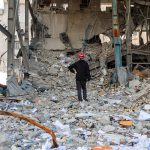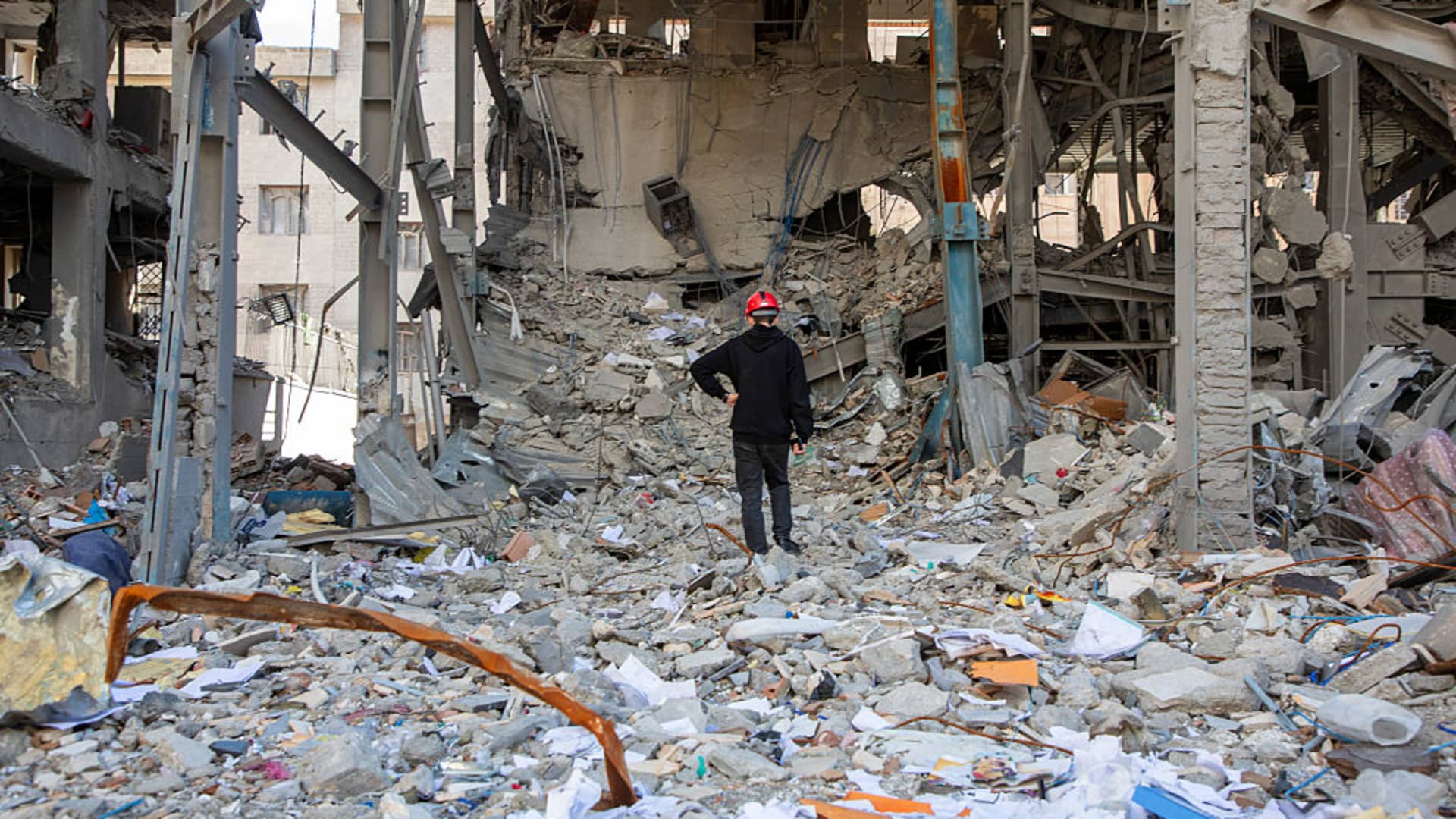
A man walks among buildings destroyed in a joint attack by Israel and the United States on April 6, 2026, in Tehran, Iran.
Majid Saeedi | Getty Images
Policymakers around the world are closely watching developments in the Middle East as they gauge the most prudent response to the economic fallout of the war.
CNBC spoke to more than 30 central bankers, politicians and policymakers at the IMF World Bank meetings in Washington, DC, this week, who weighed in on the U.S.-Iran war and their biggest economic concerns.
The interviews came before Iran’s Friday declaration that the Strait of Hormuz is completely open to commercial traffic during the ceasefire between Israel and Lebanon, and its subsequent statement on Saturday that the key energy chokepoint was closed again because the U.S. had failed to meet its obligations.
U.S. President Donald Trump on Friday thanked Iran for opening the strait in a social media post. But Trump said the U.S. naval blockade of Iran’s ports will remain in effect until an agreement is reached with Tehran.
1. A drawn out war
The war in Iran dominated conversation at the event, amid lingering uncertainty around its trajectory.
Overnight, Trump said at an event in Las Vegas that the war “should be ending pretty soon.”
On April 1, the president said he expected the war to last another two to three weeks. Since then, there has been mixed messaging out of Washington and Tehran, and little clarity on the status of peace talks.
“I’m being asked all the time now, is this war going to have a lot of impact? The first answer is, it has already had an impact,” Pierre Gramegna, managing director of the European Stability Mechanism, told CNBC’s Karen Tso on the sidelines of the IMF World Bank meetings. “I mean, look at inflation rates in the last months. Look at what’s going on in our gas stations all over the world. The impact is obvious.”
Quoting the Colombian writer Gabriel García Márquez, Gramegna’s answer to whether the war and its impact will last was “it is easier to start a war than to end a war.”
“To start a war, you don’t need to ask anybody, you’re on your own. But to end it you need to agree, bilaterally, multilaterally, and this uncertainty is weighing, obviously, on how we look at the future.”
On Thursday, as the conflict neared its eighth week, Trump said Washington and Tehran were close to making a deal.
Bank of France Governor François Villeroy de Galhau told CNBC, however, that policymakers “cannot bet only on the most favorable scenario.”
“There is unprecedented uncertainty, even unknown,” he said. “(The war) could be prolonged, there could be secondary effects, not only on energy, but also on some other products. So in our case, we expect higher inflation and we expect lower growth.”
Elisabeth Svantesson, finance minister of Sweden, warned that “we haven’t seen all the facts of this crisis yet, (and) it could be pretty bad.”
“It depends on, of course, the intensity and duration of the war, but it affects people around the world,” she said. “Everyone is affected in one way or another, so I guess global demand will be lower, and so will growth.”
2. Stagflation
Many of those who spoke to CNBC flagged growth and inflation challenges, with stagflation being a key concern.
“If (the war goes on) longer, the impact on inflation is what would worry me most. If it lasts a couple of months more, if the Strait of Hormuz is blocked or half-blocked, then we’re going to have inflation that goes up more than 1%, maybe 1.5% this year,” said Pierre Gramegna, managing director of the European Stability Mechanism.
“If it’s even worse and it lasts longer (than that), inflation would go up 2.5% percent — that would trigger probably stagflation, and that’s bad news for the world.”
3. Energy security
Greek Finance Minister Kyriakos Pierrakakis warned that the world is “potentially looking at the greatest energy crisis in history.”
“And if you add up all the other elements, one third of fertilizers pass through the Strait (of Hormuz) — sulfur, helium, petrochemicals — collectively, it can potentially be a huge risk,” Pierrakakis told CNBC’s Tso. “Plus, April can be more problematic than March, because right now, the last ship cargoes that left on Feb. 28 are due to arrive by April 20. So, (supply constraints) will be felt in the markets more significantly.”
Nicola Willis, finance minister of New Zealand, cautioned that a prolonged conflict would bring about a “worst-case scenario” in which crude oil is trapped in the Middle East, unable to reach refineries in southeast Asia.
“We could (then) be looking at shortages for our part of the world,” she told CNBC’s Tso. “We’re preparing for those sorts of worst-case scenarios, and seeing inflation endure outside of the target band is something that we do have to anticipate could happen in a worst-case scenario.”

French Finance Minister Roland Lescure told CNBC Europe needs to double down on electricity to build resilience in its energy markets.
“We’re going to invest in nuclear, we’re going to invest in renewables,” he said of France.
“This crisis is showing once again (that) we need more independence, we need to be more sovereign,” he said. “We have to rethink climate change as an opportunity and not as a threat, and hopefully by the time the next crisis comes — because I’m afraid there will be more — we’ll be even more sheltered than we are today.”
Meanwhile, Krishna Srinivasan, head of the Asia department at the IMF urged “every country in Asia” to consider diversifying their energy supply chains.
4. ‘Fog’ and ‘cloud’ creating policymaking challenges
Policymakers who spoke to CNBC in Washington also said it had become difficult to forward plan due to the enduring uncertainty.
“It’s absolutely impossible to predict what will happen, forecasts are very uncertain,” said Sweden’s Svantesson.
Olli Rehn, governor of Finland’s central bank and a member of the European Central Bank’s Governing Council, stressed that ECB policymakers “have not pre-committed to any rate path,” even as markets price in a series of hikes for the euro zone this year.
“There is no clarity, no certainty about the key factors, (including) the duration of the conflict,” he said. “That depends very much on the negotiations, and it depends on how serious damage has been done to energy production and transport routes,” he told CNBC. “The outlook is very foggy for the moment, so … the optional value of waiting is quite high.”

Joachim Nagel, president of Germany’s Bundesbank and another ECB Governing Council member, described the situation as “very opaque, very cloudy.”
The ECB is due to hold its next meeting on monetary policy in two weeks’ time. Nagel said that with news on Iran coming in daily, policymakers were taking a “meeting-to-meeting approach.”
“In two weeks, we can see a lot of new things coming,” he explained. “So I’m really cautious to give a proper indication what is the next step we have to do on the monetary policy side.”
Bank of Slovenia Governor and ECB Governing Council member Primoz Dolenc told CNBC the war was making it “quite difficult to assess what monetary policy will have to do.”
“According to (our) baseline scenario, we will not have to act in monetary policy stance because we assumed that this supply shock will go as fast as it came. But I don’t know whether this scenario is realistic or not,” he said. “Right now, I would say we are still lacking full availability of information in order to assess what kind of monetary policy we will have to use.”
5. Market resilience
Global equity markets have largely shrugged off the impact of the Iran war, with U.S. equities notching fresh records in Thursday’s session. The MSCI World Ex-U.S. index is still down roughly 1% since the war began, but has regained more than 8% over the past month.

S&P 500 index
“The markets have operated in quite an orderly way,” Verena Ross, chair of the EU regulator the European Securities and Markets Authority, said. “Market players have been able to meet margin calls and things like that. So there has been quite some resilience in how the markets have operated. The question is, how will markets continue to cope with increased volatility that seems to be happening on a daily basis?”

Martins Kazaks, another ECB Governing Council member and head of Latvia’s central bank, told CNBC’s Tso that the market reaction to the war was unexpected.
“Financial markets, which is surprising to me, are back where they were before the war started,” he said. “(But) only now will we see what’s going to be the impact on supply, because ships are just arriving, and (many) ships have not sailed yet, so there is going to be an interruption, and we’ll see how this will going to affect the real part of the economy.”