Despite escalating political pressure from President Donald Trump, the Federal Reserve is expected to hold interest rates steady at its policy meeting this week.
Amid a somewhat softening labor market, inflation pressures and an uncertain geopolitical landscape, futures market pricing is implying almost no chance of a rate cut, according to the CME Group’s FedWatch gauge.
The Fed’s pause may disappoint Americans eager for lower debt payments, according to Matt Schulz, LendingTree’s chief credit analyst.
“Even so, rates on several types of loans are at their lowest levels in years and are likely to keep falling, at least for a little while longer,” Schulz said. “That’s welcome news as affordability issues continue to plague families around the country.”
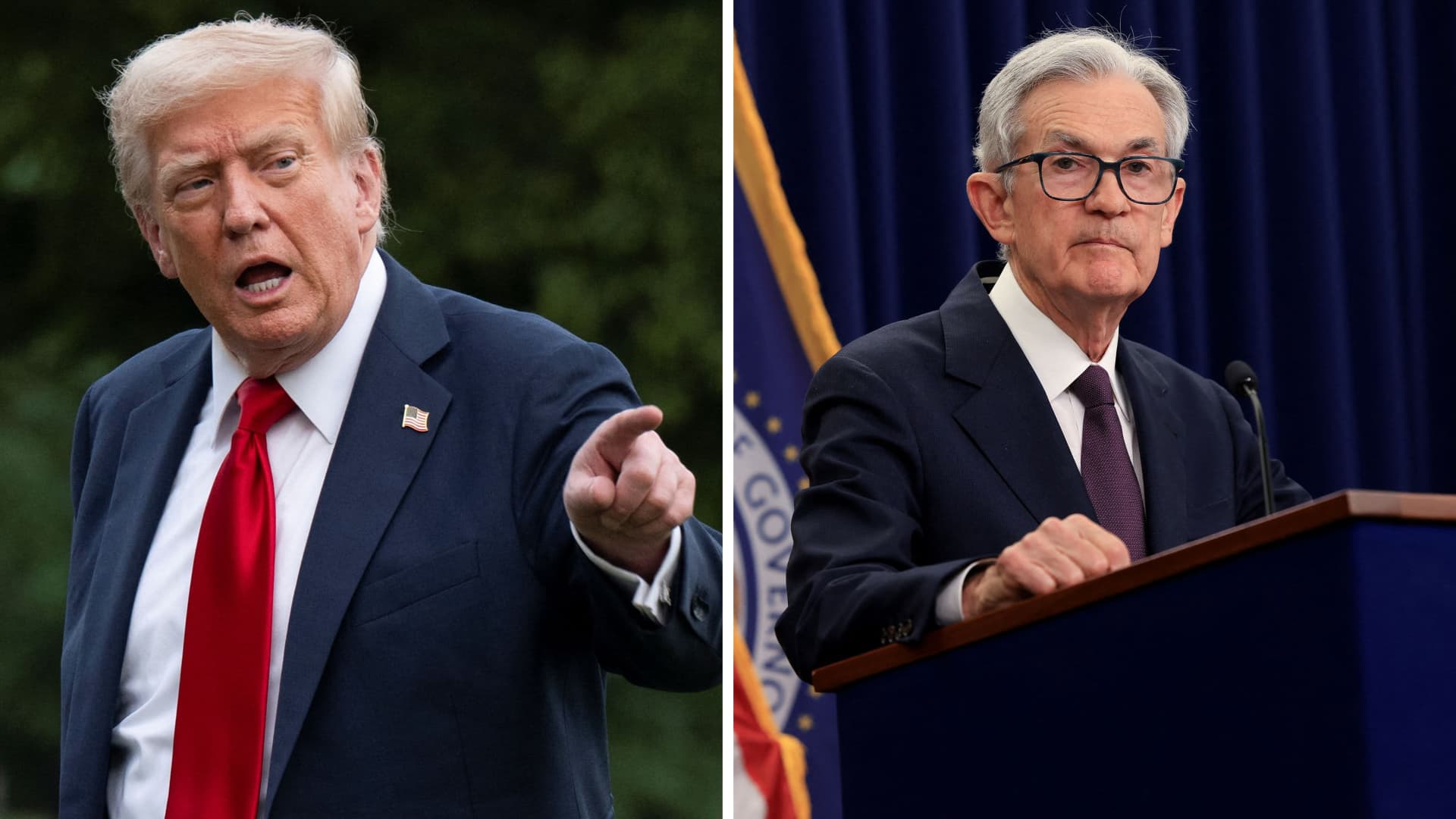
Trump vs. Powell
Should the Fed pause as expected, Trump is likely to be the most vocal critic of the central bank’s decision.
The president ratcheted up his criticism of Fed Chair Jerome Powell at the World Economic Forum in Davos, Switzerland, last week and said in a CNBC interview that he had narrowed down the list of candidates to succeed Powell “down to maybe one.” He’s widely expected to pick someone who is inclined to cut rates more aggressively.
The president said in remarks last week that inflation has been “defeated.” He has also said in prior comments about the Fed that maintaining a federal funds rate that is too high makes it harder for businesses and consumers to borrow, putting the U.S. at an economic disadvantage to countries with lower rates.
President Donald Trump gestures as he delivers a special address during the World Economic Forum annual meeting in Davos, Switzerland, Jan. 21, 2026.
Mandel Ngan | Afp | Getty Images
The Fed’s benchmark sets what banks charge each other for overnight lending, but also has a trickle-down effect on many of the borrowing and savings rates Americans see every day.
Shorter-term rates are more closely pegged to the prime rate, which is typically 3 percentage points above the federal funds rate. Longer-term rates are more dependent on inflation expectations and other economic factors.
Altogether, the impact of the Fed’s actions varies significantly across different types of loans.
Mortgages
The average rate for a 30-year, fixed-rate mortgage was 6.19% as of Friday, according to Mortgage News Daily, down from over 7% a year ago — helped in part by Trump’s push to have Fannie Mae and Freddie Mac buy $200 billion in mortgage bonds.
Just on Trump’s announcement of that plan, the average rate on the 30-year fixed-rate mortgage sank briefly below 6% earlier this month.
“Mortgage rates did dip below 6% in recent weeks for the first time in years, only to spike again this past week due to geopolitical chaos surrounding Greenland,” said Melissa Cohn, regional vice president of William Raveis Mortgage. If tensions simmered, rates could ease again, she said, but “rates go up way faster than they come down.”
Credit cards
By contrast, most credit cards have a variable rate, so there’s a more direct connection to the Fed’s benchmark.
Following three consecutive rate cuts in 2025, the average credit card interest rate in the U.S. fell to 23.79% in January, marking the lowest level since March 2023, according to LendingTree.
Still, “those rates are not going to come down to a level that is going to ease the burden on those who are carrying a balance,” said certified financial planner Stephen Kates, a financial analyst at Bankrate.
Currently, about 175 million people in the U.S. have credit cards, and while some pay off the balance each month, roughly 60% of credit card users have revolving debt, according to the Federal Reserve Bank of New York.
However, Trump is trying to have a hand in here, too. Trump’s call for a temporary 10% cap on credit cards, could mean significantly lower interest rate charges for those who carry a balance from month to month. Yet executives at some of the biggest U.S. banks, including JPMorgan Chase CEO Jamie Dimon, have said this type of policy “would be an economic disaster.”
Auto loans
Trump recently said that car payments, among other expenses, are “coming down.”
Although interest rates on new-car loans have edged lower, car buyers are financing larger amounts, so the affordability crunch has only worsened.
The average amount financed for a new car reached an all-time high of $43,759 at the end of last year, according to Edmunds. The average monthly payment on a new-vehicle purchase is at a fresh high, as is the share of new-car buyers with an auto payment of $1,000 or more.
“The borrowing landscape remains quite unfriendly for car buyers, who are still dealing with sky-high prices and interest rates that have not meaningfully budged despite the three rate cuts last year,” said Joseph Yoon, consumer insights analyst at Edmunds.